

Here are the 10 most central claims that have shaped the debate about Greenland

-
A stream of false claims has flourished in the public debate since US President Donald Trump reiterated his desire to own Greenland.
-
TjekDet has compiled the most important claims with an accompanying fact check.
This article is brought to you by the Danish fact-checking media TjekDet. The article is a translation of a Danish version: Her er de 10 mest centrale påstande, der har præget debatten om Grønland.
Donald Trump revived his desire to own Greenland for reasons of national security when he was reinstated as President of the United States a year ago. And over the past month, the rhetoric has intensified.
Donald Trump himself, other American politicians, and American influencers have put forward a wide range of claims that have attracted significant international attention and have been intended to support and legitimize the American desire to take over Greenland.
TjekDet has fact-checked several of the claims and answered questions that have circulated in the public debate. Many of the claims are far from the truth.
In this article, we have compiled the most dominant claims that are either completely incorrect or have called for nuance and context.
1. “There are Chinese ships everywhere near Greenland”
Donald Trump has repeatedly, in various versions, claimed that China is militarily present in and around Greenland with warships and submarines. He has both said that the Chinese are already militarily present everywhere, but he has also said that this will happen if the United States does not intervene and gain control of the world’s largest island.
But according to the Danish Defence Intelligence Service’s (FE) report ‘Udsyn 2025’ from December 2025, China is not yet militarily present in the Arctic.
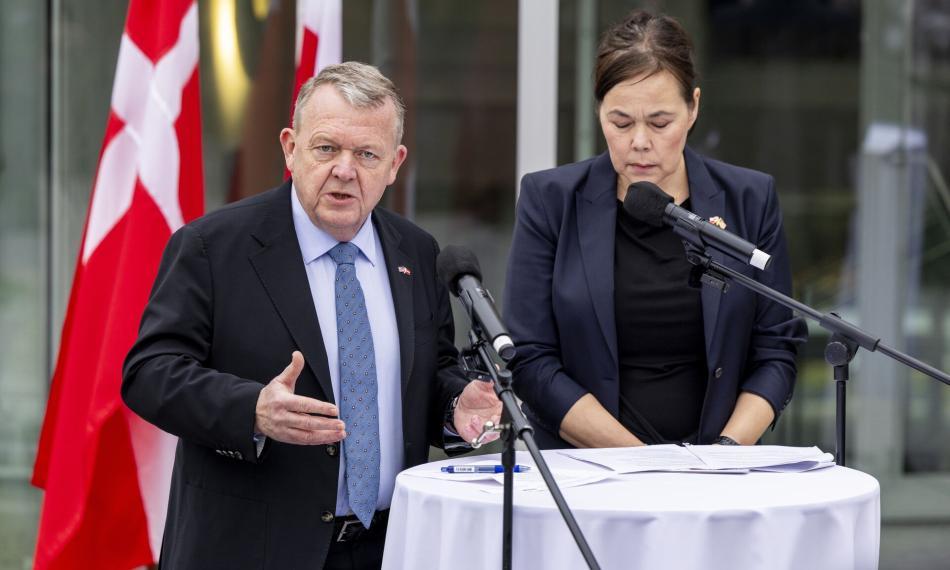
At a press conference, Denmark’s Minister of Foreign Affairs, Lars Løkke Rasmussen, also challenged Donald Trump’s claim about the Chinese ships.
“It is not true that there are Chinese warships everywhere. According to our intelligence, there has not been a Chinese warship in Greenland in the past decade,” Lars Løkke Rasmussen said.
FE does note, however, that China is preparing to be militarily present in the Arctic with the ultimate goal of “being able to sail missile submarines under the ice cap in order to achieve the same capability as Russia and the United States to retaliate against attacks with nuclear weapons.” In addition, FE writes that China’s long-term interests in the Arctic also include Greenland.
2. “There are Russian ships and submarines everywhere near Greenland”
As with China, Donald Trump has claimed that there are Russian warships and submarines everywhere near Greenland.
But that claim is incorrect, according to two experts whom TjekDet has spoken to.
“Trump is talking about the coast, and it is not correct that there are Russian ships here. We know that from the Arctic Command, and we have solid data on it,” Marc Jacobsen, who is an associate professor at the Department of Strategy and War Studies at the Royal Danish Defence College, said.
Jørgen Meedom Staun, who is also an associate professor at the Department of Strategy and War Studies at the Royal Danish Defence College, says that the Russians are less active than previously in the GIUK gap, which is the waters between Greenland, Iceland, the Faroe Islands, and the United Kingdom.
Danish Defence Intelligence Service’s assessment is that Russia has extensive plans for its entire Arctic area – both militarily and civilian – and that Russia “at times is active with submarines, surface vessels, and aircraft near both Greenland and the Faroe Islands and throughout the entire area between them.” What this means more specifically, TjekDet has not been able to get clarified by FE.
3. The United States must own Greenland in order to be able to defend it and the Arctic
Donald Trump has repeatedly put forward the claim that the area around the Arctic cannot be protected against Russia and China unless the United States owns Greenland.
But it is stated quite explicitly in the agreement between the United States and the Kingdom of Denmark in 1951 on the defense of Greenland that the Americans do not need ownership in order to defend Greenland militarily. The agreement also states that the United States has free access everywhere in Greenland and that it can place all the soldiers and bases it wants. The agreement further entails that the United States, as a member of NATO, is obligated to assist Denmark in the defense of the island.
Over the years, there have been many American soldiers in Greenland. In the late 1950s, there were between 8,500 and 10,000 distributed across 18 bases, but that number has fallen sharply. Today, there are just over 100 American soldiers at Pituffik Space Base, formerly known as Thule Air Base.
Read more about the United States’ military presence in Greenland in our article here.
4. Donald Trump: “For 20 years, NATO has told Denmark that you need to remove the Russian threat from Greenland”
“For 20 years, NATO has told Denmark that you need to remove the Russian threat from Greenland. Unfortunately, Denmark has not been able to do anything about it. Now the time has come, and it will be done!!!,” Donald Trump wrote on Truth Social on January 19 this year.
But Rasmus Brun Pedersen, who is an associate professor at the Department of Political Science at Aarhus University, finds it hard to imagine that this should be the case.
“It would also be wrong to do so, because it would be a task for the alliance. And therefore, it is not Denmark’s isolated responsibility to deter or keep the Russians away in the Arctic area,” he told TjekDet.
The Danish Minister of Defence, Troels Lund Poulsen (V), writes in an email to TjekDet that he in no way recognizes the picture Donald Trump paints and adds that the government is fully engaged in strengthening the Armed Forces’ task performance in the Arctic and the North Atlantic.
The 20-year-old Ilulissat Declaration, which is about the Arctic being a low-tension area, even argues for the opposite. In the declaration, Denmark committed itself together with the other Arctic countries – the United States, Canada, Russia, and Norway – not to rearm or build up larger military forces in the Arctic.
Read our full fact-check of Donald Trump’s claim here.
5. Can Denmark sell Greenland, and who would receive the money?
In the debate about the American desire to take over Greenland, a Danish sale has been mentioned as a possibility, and Donald Trump has repeatedly said that he wants to buy Greenland.
But it is not at all possible for Denmark to sell Greenland, experts tell TjekDet. It would be a clear violation of both the Self-Government Act and international law if Denmark were to hand over Greenland to, for example, the United States in exchange for money, says Miriam Cullen, who is an associate professor at the Faculty of Law at the University of Copenhagen.
“The Self-Government Act makes it very clear that a decision on Greenland’s independence must be made by the people of Greenland,” she told TjekDet.

It has also been mentioned in the public debate that Denmark should sell Greenland because it could finance welfare and infrastructure in Denmark for many years.
But because it is not at all possible constitutionally for Denmark on its own to sell Greenland, it does not make sense to speculate about how much money Denmark could get for selling Greenland. That is what Frederik Harhoff, professor emeritus at the University of Southern Denmark, says.
Money from a potential sale would go to the Greenlanders and can therefore only happen if Greenland, as an independent nation, decides to sell itself to the United States.
Read our fact check on whether Denmark can sell Greenland and who would get the money.
6. Can the Greenlanders themselves decide their future?
A potential decision on Greenland’s independence must be made by the Greenlanders. This is set down in the Self-Government Act, which was adopted in 2009.
Before the Greenlanders can break away from Denmark, a referendum must take place in Greenland. If there is a majority in favor of independence, the Greenlandic government, Naalakkersuisut, must initiate negotiations with the Danish government.
Before the agreement between the Greenlandic and Danish governments can be implemented, the Danish Parliament must vote the agreement through. This means in principle that Denmark can prevent Greenland from becoming independent, but according to Miriam Cullen, this is highly unlikely, because the Danish and Greenlandic governments will presumably have spent several years negotiating the agreement.
Should the Danish Parliament nevertheless – against expectations – vote against Greenland’s independence, Denmark would run into problems with international law, she assesses.
“If the Danish Parliament said no to a decision made by referendum in Greenland, it would likely be in violation of international law. And it is possible that it could end up in an international court,” Miriam Cullen told TjekDet.
Once the agreement has been approved by both governments, Greenland can leave the Kingdom of Denmark, after which an independent Greenlandic state will be established. Greenland must then apply for admission as a new independent state to the United Nations, so that Greenland can get its own seat in the UN General Assembly and be recognized by other states, Frederik Harhoff told TjekDet.
7. Do the Greenlanders want to be part of the United States?
On January 26, 2025, Donald Trump told journalists aboard Air Force One that Greenland’s nearly 57,000 inhabitants “want to be with us.” Vice President J.D. Vance repeated the claim when he visited U.S. troops in the United States in March last year.
But nothing supports that claim. The analysis institute Verian published a survey on January 29, 2025, conducted for the Danish newspaper Berlingske and the Greenlandic media outlet Sermitsiaq, which showed the exact opposite picture.
In it, 85 percent of Greenlanders answered no to the question of whether they want to leave the Kingdom of Denmark and instead become part of the United States. Only six percent answered yes.
Read our full fact-check of the claim here.

8. What right does Denmark have over Greenland
In a letter to Norway’s Prime Minister, Jonas Gahr Støre, Donald Trump claims that there are no written documents that cement Denmark’s “ownership right” over Greenland.
But Emil Andersen, a researcher in Greenlandic and Danish history at the National Museum, explains that there are in fact three written documents. The first dates from 1814 in connection with the Treaty of Kiel, when Denmark ceded Norway to Sweden, but Denmark retained Greenland, Iceland, and the Faroe Islands.
The second document dates from 1916 in connection with the sale of the Danish West Indies to the United States. Here, the then U.S. Secretary of State, Robert Lansing, writes that the United States will not object if Denmark expands its interests in Greenland.
According to Søren Rud, a researcher in postcolonial relations at the University of Copenhagen, the most important document dates from 1954.
“After the Second World War, Denmark had to deal with the fact that Greenland was a Danish colony. In a referendum in Denmark in 1953, a new constitution was voted on, and part of it was that Greenland became part of the Danish realm. The year after, in 1954, a resolution was put to a vote at the UN, where the United States voted to recognize that Greenland had become part of Denmark, and in that context, you have a written document that documents Denmark’s right to Greenland,” Søren Rud told TjekDet.
Watch our video where we fact-check the claim from Donald Trump.
9. Did Denmark arrive to Greenland by boat 500 years ago?
Donald Trump also sees no historical reason why Greenland should belong to the Kingdom of Denmark, because according to him, Denmark claim Greenland because its ancestors arrived there by boat 500 years ago.
That is what he said at a press conference at the White House on January 9 this year. Previously, he has said that it was 200 years ago, but the point was the same.
Neither is correct, however. Danish footprints began with the Vikings 1,200 years ago.
Read our fact-check of the claim, where two researchers take us even further back.
10. Did Denmark steal Greenland from Norway?
On social media – especially on X – it has been widely shared that Denmark allegedly stole Greenland from Norway. This is said to have happened after the Napoleonic Wars in 1814.
“Denmark was forced to cede Norway but illegally retained Norway’s overseas territories: Greenland, Iceland, and the Faroe Islands,” reads, among other things, a post that has nearly half a million views.
But there is no historical evidence for this, several researchers have stated to TjekDet.
“For me, it is outright wrong,” associate professor Søren Rud told TjekDet.
According to the researchers, Denmark’s defeat in the Gunboat War led to Denmark having to cede Norway to Sweden in the Treaty of Kiel. But Denmark retained Greenland, the Faroe Islands, and Iceland in the negotiations, which were governed by Great Britain, which stood as the victor after the Gunboat War.
Get all the nuances in our fact-check here.
May have unpredictable consequences
At the fact-checking media outlets, Donald Trump’s attempts to take over Greenland have filled much of the past year, and Thomas Hedin, editor-in-chief of TjekDet, particularly notes the number of false claims that have helped create fear among both Danes and Greenlanders.
But it is his assessment that most people are well aware that many of these claims are simply not true, and therefore the claims do not seem to have had the classic effect that influence campaigns otherwise seek – namely to create division and shift opinions.
“What affects the information environment far more is the constant pressure: the repeated threats, the hostile tone, and the sense that the situation can escalate. Paradoxically, this external pressure has so far strengthened cohesion rather than division, despite a historically tense relationship between Greenland and Denmark,” Thomas Hedin said.
However, he emphasizes the seriousness of what the many false claims can lead to.
“Disinformation and influence campaigns lay the groundwork for deeply erroneous decisions – decisions that can trigger serious and unpredictable consequences for our societies, democracies, and our ability to coexist, whether in Denmark, Greenland, Europe, or beyond,” Thomas Hedin said.
He adds that if a narrative were suddenly to spread that could actually create division in the Realm Community, the situation could quickly change.

